Tag: Sao Paulo

  • The results of our mission [Newsletter 4 Brazil]

    The results of our mission [Newsletter 4 Brazil]

    Hello to all,

    Our adventure with the NGO Arca is almost over. For the 7th consecutive year, we had the privilege to share the daily life of a team of incredible activists. When you watch TV, you can sometimes get the blues by telling yourself that the world is going badly. By taking the time to look, I can tell you that countless positive initiatives like Arca exist and are changing the world without making headlines.

    Achieving impact is complex:

    Romain Sion Sao Paulo Arca Da Saber Brazil

    The goal of Arca Do Saber’s program is very clear: to develop self-esteem and soft skills in children aged 6-14. IPSOS had measured that 67% of the favela’s inhabitants had low self-esteem. To measure the impact of Arca Do Saber, we built a framework with 54 contextualized questions on: decision-making, self-control, resilience, communication, empathy, relationship with others, self-esteem and confidence in the future. By applying this framework each year, Arca will be able to monitor the development of each child it supports and adapt its educational program.

    What is complex in building a program is the consideration of other factors that are essential to achieving a central objective. At Arca, it was necessary to develop other programs on health, nutrition, and parent support to have an impact on children’s self-esteem, which was the central objective.

    A future dental project:

    Arca Sao Paulo ONG

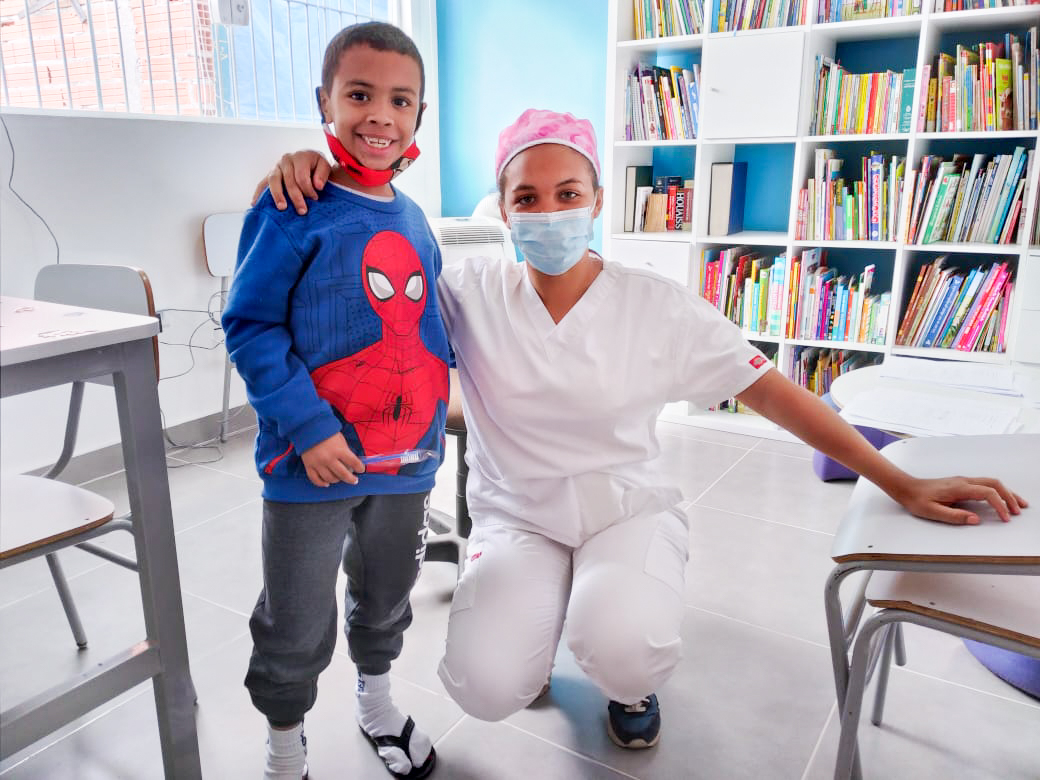
    Following her medical screening of the 130 children of Arca do Saber, Sarah was able to analyze all the data collected (extracted from the questionnaires above) and present them to the teachers of Arca. This allowed us to highlight certain findings such as: 50% of the children have never seen a dentist, 49% of the older children are ashamed of their smile, 40% of the children need to treat cavities quickly, 11% of which are in a critical state… Sarah was thus able to define a list of priorities for care as well as a list of recommendations related to prevention that can be directly applied by the teachers (eating habits, regular dental visits, brushing teeth…). Graph below on the distribution of cavities by age group.

    Arca Sao Paulo ONG

    Sarah’s file will be completed with a budget that will allow Arca’s teams to obtain financing for this project from a partner. During our stay, Thais, the president, secured a first partnership with a dentist who will take care of the children identified by Sarah. What impressed Sarah a lot during this mission was the kindness of the children when she took care of them.

    Father Assis and Cida – Two respected leaders in the favela:

    Romain Sion Sao Paulo Brazil

    Father Assis is one of a kind. With his rasta looks, he is the priest of the favela. Originally from Cape Verde, he agreed to leave everything to come and settle in Vila Prudente where he has been living for 10 years. Beyond putting himself at the service of the most destitute, he is taking law courses in order to defend the unjustly condemned prisoners. Racism is still present, and being black and having no money is not an advantage. According to Assis, it is impossible to fight if you don’t know your rights.

    Cida is Arca’s kitchen manager. After working in a big restaurant, she left everything to be closer to her family living in the favela. Although her dishes are delicious, her role goes far beyond that. Having close relatives high up in the drug trade, she plays the role of intermediary for Arca. For example, the day Valérie Trierweiler came to visit the favela, no mistakes were allowed. Thanks to Cida, everything went well.

    A nice surprise for our departure:

    Romain Sion Sao Paulo Arca Da Saber Brazil

    For our last day at Arca, the children and their teachers had prepared a nice surprise for us in the canteen. They gave us a beautiful home-made box in which the children had made drawings for us. We let you discover some of them! A touching gesture for our departure! What made this project successful was the good match between Arca’s expectations and our skills.

    In the favela of Rocinha, it was tense…

    Rocinha Favela

    In Rio, 3 clans clash: the Red Command, the Third Command and the ADA. Yesterday morning, we were in the favela of Rocinha in Rio with a local guide. Rocinha is the territory of the Red Command. You can see it on the walls, where the initials CV (Comando Vermelho) are tagged. Impossible to take pictures here, but here is what struck us…

    The network is very organized. Guards are posted at each entrance to prevent police raids. The closer we got, the more heavily armed the guards were. What struck us was the age of the guards: 14-15 years old on average. The first one we met must have been 12-13 years old at most. He was walking with an AK-47 with a skull on it.

    Rocinha Favela

    A little further on was the dealing point. Several dozen guards armed with AK-47s, sniper rifles or machine guns were standing guard near a table set up in the middle of the street. Cocaine and marijuana were the main products for sale. A little apart, in a bar, we saw the accountant sorting several bundles of money. This seemed out of the ordinary to us, but in reality it was an everyday scene in the favela. Seeing us a little perplexed, one of the clan leaders approached the guide and said: “Don’t worry, you can relax. You have nothing to fear here. Just no pictures.”

    We were told that the traffic had other sources of profit such as racketeering. When a business wants to set up in the favela, it has to pay “taxes”. This concerns especially the activities of: sale of gas, transport, installation of wi-fi and TV cable which bring in up to 400k€ per week. In return for these juicy profits, these small local warlords cannot leave the favela and their life expectancy is very short.

    Rocinha Favela

    What is counter-intuitive is that these organizations are not only seen as bad by the community. In some cases, they help families in need with food, medicine… They help more than the government, which has sometimes abandoned these families by deserting their neighborhoods.

    We would never have done this without a guide who knew the area perfectly and, above all, had the right connections. What will remain engraved in our memory is the age of these young people who get drawn in. Maybe because of the lack of opportunities offered to them, or because some of them no longer believe in their future. Especially since the guide explained to us that a vicious circle has set in: many girls become pregnant at around 15-16 and end up raising their children alone. Their difficulty in making ends meet often has a detrimental effect on the education and future prospects of their children.

    Why do so many people continue to crowd into the favelas?

    Rocinha Favela

    One of the main reasons is transportation to work. Many people work in the center of the city. Living outside the favelas would take too much time and be too expensive.

    Although often neglected by the government, the favela residents are essential to the smooth running of the city. The drivers, the security guards, the cashiers, the surface technicians, the nannies… most of them live in the favelas. The drug traffickers that we have in mind represent only a tiny minority.

    At the end of this day full of discoveries, we met a talented capoeira group. They shared their art and their passion with us. There is incredible talent in the favela of Rocinha too.

    Tomorrow is the big return!
    Have a nice day, everyone, and see you soon,
    Sarah & Romain

    Romain Sion Brésil
  • Our mission at Arca [Newsletter 3 Brazil]

    Our mission at Arca [Newsletter 3 Brazil]

    Hi everyone,

    I hope you are all well.
    After 3 weeks in Brazil, it’s time to tell you about our respective missions with the NGO Arca.

    Measuring the impact of an educational program:

    Romain Sion Arca Do Saber Sao Paulo

    Like any NGO, measuring impact is a key issue. The team in charge of the Arca Do Saber program has so far built its impact reports from the indicators requested by its donors. For example, the city council – the main funder of the program – is interested in very factual data such as: the re-enrollment rate from one year to the next (90%) or the participation rate of the beneficiaries (88%).

    Thais, the president of the NGO, asked me to think about new indicators that would allow them to measure the impact of this program over time. These would allow them to iterate more easily on the construction of their educational program. In collaboration with the teachers, a psychologist, the pedagogical manager and the evaluation manager, I am in charge of developing a framework to measure the development of self-esteem and soft skills of the children part of the program.

    Dental field data collection project:

    Arca do saber

    On Sarah’s side, Arca was interested in a mission to screen the 130 children in the program and then collect data in order to build a new project within Arca. Before our arrival, Sarah had used the recommendations of the World Health Organization to build two documents: a quantitative questionnaire (dental follow-up, eating habits,…) and a clinical report.

    During 3 weeks, Sarah received all the children in an improvised medical office on the top floor. Each visit was the subject of a detailed report allowing: to identify critical cases in order to define an emergency treatment plan with the partner dentist and to collect enough data on the children’s dental health to set up a sustainable funding project.

    The kingdom of soccer:

    Romain Sion Sao Paulo

    As you might have guessed, in Brazil soccer is almost a religion. During the big games, we were told that the streets are absolutely deserted. It is also very common to go and play soccer with colleagues after work. That’s why I was invited by some employees of the Sao Paulo subway who are fervent supporters of the Corinthians team for one of their weekly tournaments, on Friday night. What I can tell you is that the level was crazy.

    Romain Sion Sao Paulo

    We also went to the Morumbi stadium (80,000 seats) where a championship game of Sao Paulo Futbol Club X Bragantino was taking place. Being unable to find tickets, a security guard of the stadium saw us perplexed in the middle of the supporters. He was very kind and bent over backwards to help us find tickets. The result was a 3-0 victory at home – the atmosphere was clearly great! What surprised us a lot was the proportion of women and children who came to support their favorite team. Going to a game seems to be a family activity.

    The Samba:

    Sao Paulo

    Music and dance are part of the daily life of Brazilians. What Sarah and I quickly realized was that it would be impossible to match them in dance. So we just learned the basic steps of the forro and the samba. Every Sunday (even in winter), the city closes one of the main avenues of Sao Paulo to cars – Paolista Avenue. As you walk up the avenue, hundreds of singers and dancers set up shop to share their style of music.

    Sao Paulo

    Even more impressive are the samba schools that rehearse every week in preparation for the carnival. It’s a football-like championship with different leagues. During the carnival, up to 4000 people from the same Samba school can pass in front of the juries at the same time. It is a crazy organization! During the rehearsals, what marked us within the Vai Vai school, it is the very family character of these rehearsals where we found there people of all the ages.

    One more week and it will be the big comeback!
    Beautiful day to all,
    Sarah & Romain

    Sao Paulo

  • The Super Power of the NGO Arca [Newsletter 2 Brazil]

    The Super Power of the NGO Arca [Newsletter 2 Brazil]

    Hi everyone,

    I hope you are well.

    We have been in São Paulo for two weeks now. Sarah and I have settled into a routine: every morning, we go to Arca for our mission.

    The main issues in the Favela de Vila Prudente:

    Arca Do Saber Sao Paulo

    What struck me was that most of the 8,000 inhabitants of the favela live in virtual isolation. Apart from those who work outside, few inhabitants ever leave. Many feel inferior or even useless in the eyes of society. The IPSOS institute published a study on this favela showing that 67% of the inhabitants had low self-esteem.

    Other indicators caught my attention: 64% of the families live on an income of less than €320 per month, 50% do not have access to health services, 52% have not gone beyond elementary school and 28% of the families have had a teenage pregnancy.

    The NGO Arca:

    Arca Do Saber Sao Paulo

    It is in this context that the NGO Arca was born, some twenty years ago. Their mission: to accompany the development of the favela’s inhabitants by promoting their autonomy and self-confidence while offering them educational and training opportunities.

    Arca Do Saber Sao Paulo

    Since our arrival, we have discovered their 2 main areas of activity:

    • Arca Do Saber: as families often cannot afford to pay for activities outside of school, children aged 6 to 14 are often left to their own devices and exposed to risks such as drug trafficking. Arca offers socio-educational, linguistic and sports activities to more than 130 children so that they can develop their soft skills and especially their self-esteem.
    • Arca Do Crezer: Young people and adults with a low level of education are often victims of prejudice and lack professional opportunities. From the age of 15, Arca offers 13 state-recognized vocational training courses (bakery, sales, logistics…) via their training and orientation center.


    Arca’s superpower:

    Romain Sion Arca Do Saber Sao Paulo

    For an NGO with 32 employees, I was impressed by the lasting partnerships they have managed to set up with large groups such as L’Oréal, Veolia, Givaudan, Lesaffre, BNP, ID Logistics, Alstom, Air Liquide, Leroy Merlin…

    According to Thais, the president of the NGO, their partnership strategy is based on 4 axes:

    • Moving away from a charity-based positioning by adopting a solution-based approach linked to the favela’s issues.
    • Sound governance and a solid field team. Arca has succeeded in gathering a team of talented professionals who often impress partners during field visits.
    • An approach based on reliable indicators. Arca has set up a partnership with IPSOS, which guarantees the credibility of the data shared with partners.
    • An agile and flexible way of operating, which allows them to respond quickly and closely to companies’ selection criteria and budgets.

    An ingenious donation mechanism set up in the State of Sao Paulo:

    Romain Sion Arca Do Saber Sao Paulo

    One morning, I was intrigued by José, an employee of the NGO, who was busy entering a huge bag of receipts into his computer. I had to know more…

    In Brazil, a large part of the economy is still informal, so the State of São Paulo had the brilliant idea of setting up the Nota Fiscal Paulista program, which encourages individuals to ask for an invoice when making purchases.

    By giving their tax number when making a purchase with an invoice, customers get a cashback of up to 20% of the VAT amount. They have two options: keep the money or donate it to the NGO of their choice. The advantage of this funding for NGOs like Arca is that these donations are not earmarked, meaning the NGO can spend them as it wishes.

    An open-air museum:

    Sao Paulo

    What is magical about São Paulo is its artistic and cultural dimension. Over the last 5 years, street art has developed considerably, with magnificent murals painted on run-down buildings. How can this be explained? And above all, who pays for this open-air museum? A local guide explained to us that the city and the public authorities had no budget for this kind of initiative. However, faced with numerous tags on their buildings, private landlords found that these murals were a great way to fight them. This is how private companies started to finance these initiatives. Could we imagine transforming some of the so-called “ugly” places in France into beautiful artistic spaces?

    Thanks for the interest! Next week, we’ll tell you about our mission at Arca!

    Have a nice vacation and see you soon,

    Sarah and Romain

    Romain Sion Sao Paulo
  • From the Favelas of Sao Paulo [Newsletter 1 Brazil]

    From the Favelas of Sao Paulo [Newsletter 1 Brazil]

    Hi everyone,

    How are you doing?

    For the 7th year in a row, we have packed our bags to put our skills at the service of an exceptional NGO during our summer vacation. This year, with Sarah, we invite you to travel with us to Brazil and discover a Franco-Brazilian organization called Arca Do Saber, located in the heart of the favelas of São Paulo.

    Romain Sion Brésil

    To be honest, we left with some preconceptions: extreme social inequalities, sometimes dangerous districts, but an incredible atmosphere. We were in for quite a few surprises…

    Our arrival:
    Having landed in Rio de Janeiro, we took the opportunity to enjoy the splendid sunset view from the top of Sugarloaf Mountain before heading to São Paulo. An expat family had very kindly agreed to lend us their apartment. When we arrived in front of the double security gate, guarded 24 hours a day, we understood that we were entering another world. With a panoramic view, a swimming pool, a gym, staff for cooking and cleaning…, the apartment is located in the most beautiful area of the city. From the very first day, we understood that every morning we would have to bridge the huge gap between the neighborhoods where the “elite” live and those of the most disadvantaged social classes.

    Sao Paulo

    When we arrived, Thais, the director of the NGO, warmly welcomed us and introduced us to the whole team. Being a dentist, Sarah’s mission is to do a dental check-up of all the young people of the NGO in order to identify possible critical cases and to collect data to convince the municipality to release the budget. As for me, I am in charge of an impact measurement mission on one of their educational programs.

    At the entrance to the Favela:
    Although reputed to be less dangerous than Rio’s, Sao Paulo’s favelas remain important drug trafficking points. As we entered the favela, we noticed 3 lookouts filtering all the comings and goings of this entrance.

    Romain Sion Arca Do Saber Vila Prudente

    Placed in strategic spots, they can locate anyone within a few minutes with their walkie-talkies, especially plainclothes police officers. With the armed gang based at the end of the street, we quickly understood that we could not walk around just anywhere and that we had to respect some rules. To be identified as volunteers, we wear fluorescent vests marked Arca Do Saber.

    Romain Sion Arca Do Saber Vila Prudente

    What struck us was how the police are perceived: the inhabitants are more afraid of them than of the traffickers. The day before our arrival, a big police raid had taken place in retaliation for the robbery of a jewelry store. These are the most dangerous moments. For their part, the traffickers do everything to keep the peace and prevent robberies: when the inhabitants rebel, it is bad for business.

    The soul of the favela:
    Convinced that we needed to look beyond this first impression, André, the community leader in charge of all housing issues (access to water, electricity…), showed us around his neighborhood. Walking through small alleys invisible from the outside, we discovered the soul of the favela. Many artists have expressed themselves directly on the walls of the houses. The common denominator: mosaic.

    Romain Sion Arca Do Saber Vila Prudente

    But why this material? According to André, mosaic is the expression of diversity: from different pieces, you create a harmonious and beautiful whole. We then went to a chapel whose stained-glass windows were made from bottles embedded in the walls. Would you have imagined a ballet studio in the favela? There is one! Many positive initiatives exist. Culture and art are powerful levers of change, and the leaders of the favela have understood this well!

    Romain Sion Arca Do Saber Vila Prudente

    After one week at Arca Do Saber, we are still full of surprises. Before concluding this 1st newsletter, two observations: the kindness of Brazilians and their love of music. Music is one of the things that unites all Brazilians, whatever their social or ethnic background or age.

    Do not hesitate to send us your news.

    Have a nice vacation and see you soon,

    Sarah & Romain