Hello to all,
Our adventure with the NGO Arca is almost over. For the 7th consecutive year, we had the privilege to share the daily life of a team of incredible activists. When you watch TV, you can sometimes get the blues by telling yourself that the world is going badly. By taking the time to look, I can tell you that countless positive initiatives like Arca exist and are changing the world without making headlines.
Achieving impact is complex:

The goal of Arca Do Saber’s program is very clear: to develop self-esteem and soft skills in children aged 6-14. IPSOS had measured that 67% of the favela’s inhabitants had low self-esteem. To measure the impact of Arca Do Saber, we built a framework with 54 contextualized questions on: decision-making, self-control, resilience, communication, empathy, relationship with others, self-esteem and confidence in the future. By applying this framework each year, Arca will be able to monitor the development of each child it supports and adapt its educational program.
What is complex in building a program is the consideration of other factors that are essential to achieving a central objective. At Arca, it was necessary to develop other programs on health, nutrition, and parent support to have an impact on children’s self-esteem, which was the central objective.
A future dental project:

Following her medical screening of the 130 children of Arca do Saber, Sarah was able to analyze all the data collected (extracted from the questionnaires above) and present them to the teachers of Arca. This allowed us to highlight certain findings such as: 50% of the children have never seen a dentist, 49% of the older children are ashamed of their smile, 40% of the children need to treat cavities quickly, 11% of which are in a critical state… Sarah was thus able to define a list of priorities for care as well as a list of recommendations related to prevention that can be directly applied by the teachers (eating habits, regular dental visits, brushing teeth…). Graph below on the distribution of cavities by age group.
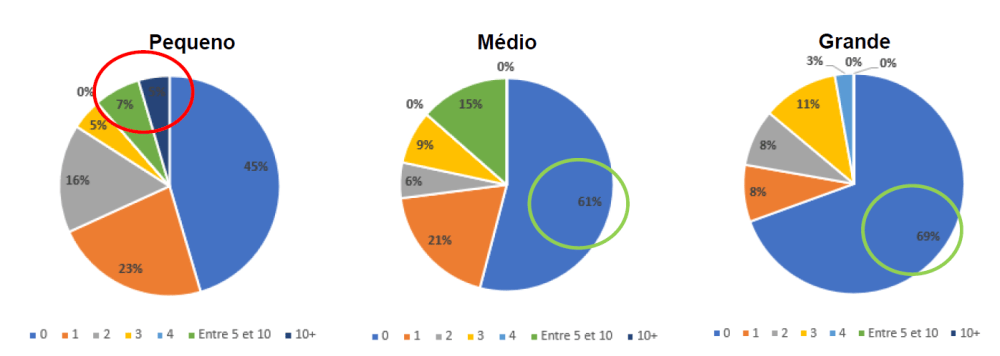
Sarah’s file will be completed with a budget that will allow Arca’s teams to obtain financing for this project from a partner. During our stay, Thais, the president, secured a first partnership with a dentist who will take care of the children identified by Sarah. What impressed Sarah a lot during this mission was the kindness of the children when she took care of them.
Father Assis and Cida – Two respected leaders in the favela:
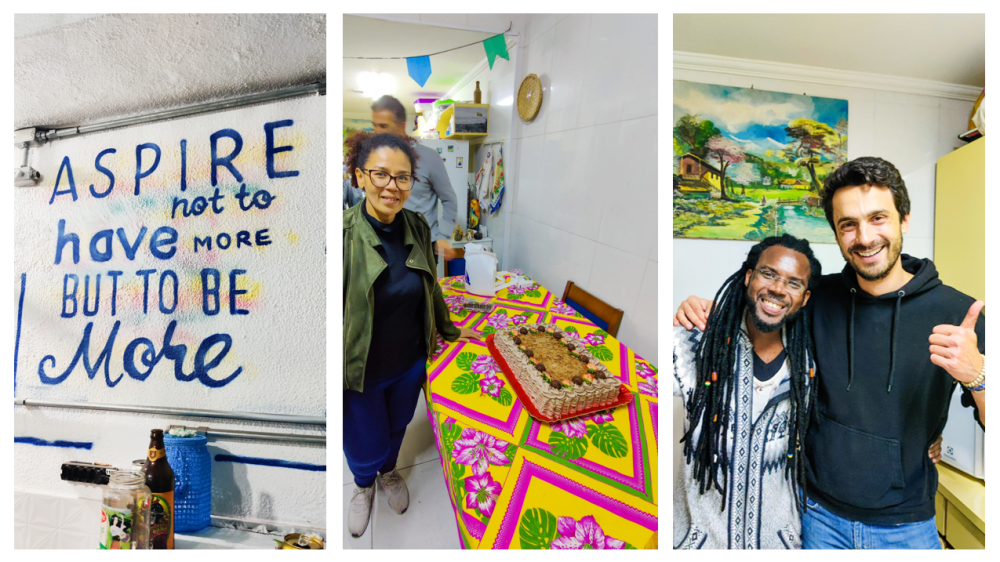
Father Assis is one of a kind. With his rasta looks, he is the priest of the favela. Originally from Cape Verde, he agreed to leave everything to come and settle in Vila Prudente where he has been living for 10 years. Beyond putting himself at the service of the most destitute, he is taking law courses in order to defend the unjustly condemned prisoners. Racism is still present, and being black and having no money is not an advantage. According to Assis, it is impossible to fight if you don’t know your rights.
Cida is Arca’s kitchen manager. After working in a big restaurant, she left everything to be closer to her family living in the favela. Although her dishes are delicious, her role goes far beyond that. Having close relatives high up in the drug trade, she plays the role of intermediary for Arca. For example, the day Valérie Trierweiler came to visit the favela, no mistakes were allowed. Thanks to Cida, everything went well.
A nice surprise for our departure:
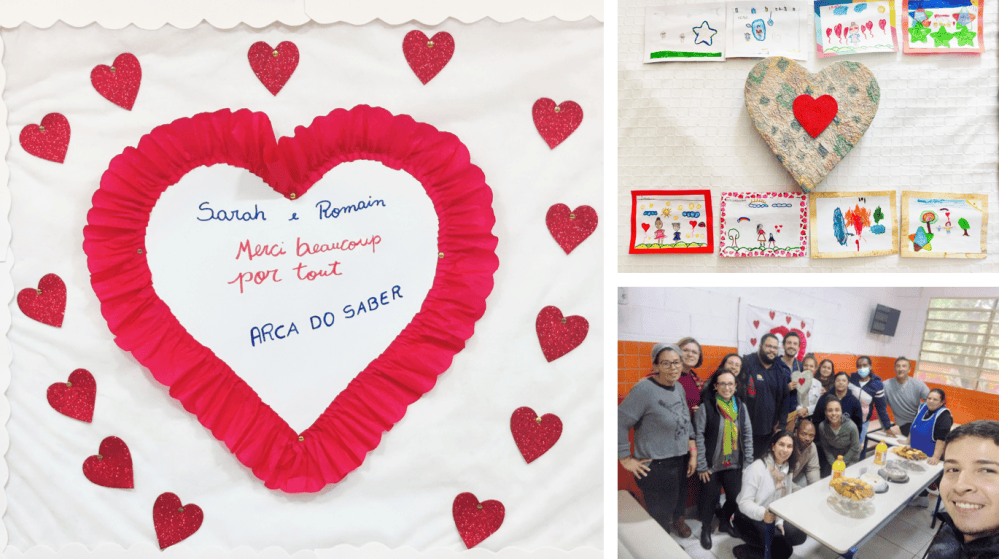
For our last day at Arca, the children and their teachers had prepared a nice surprise for us in the canteen. They gave us a beautiful home-made box in which the children had made drawings for us. We let you discover some of them! A touching gesture for our departure! What made this project successful was the good match between Arca’s expectations and our skills.
In the favela of Rocinha, it was tense…
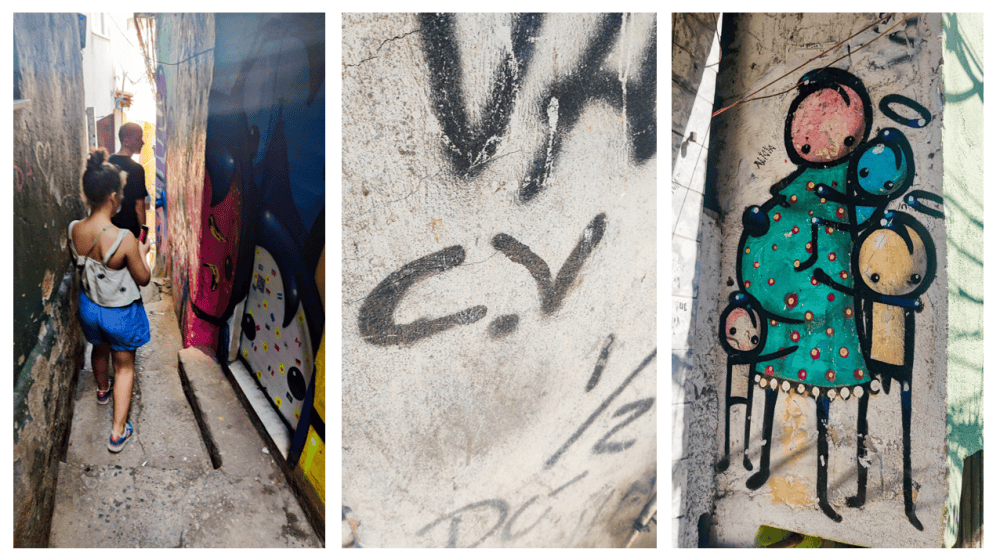
In Rio, 3 clans clash: the Red Command, the Third Command and the ADA. Yesterday morning, we were in the favela of Rocinha in Rio with a local guide. Rocinha is the territory of the Red Command. You can see it on the walls, where the initials CV (Comando Vermelho) are tagged. Impossible to take pictures here, but here is what struck us…
The network is very organized. Guards are posted at each entrance to prevent police raids. The closer we got, the more heavily armed the guards were. What struck us was the age of the guards: 14-15 years old on average. The first one we met must have been 12-13 years old at most. He was walking with an AK-47 with a skull on it.
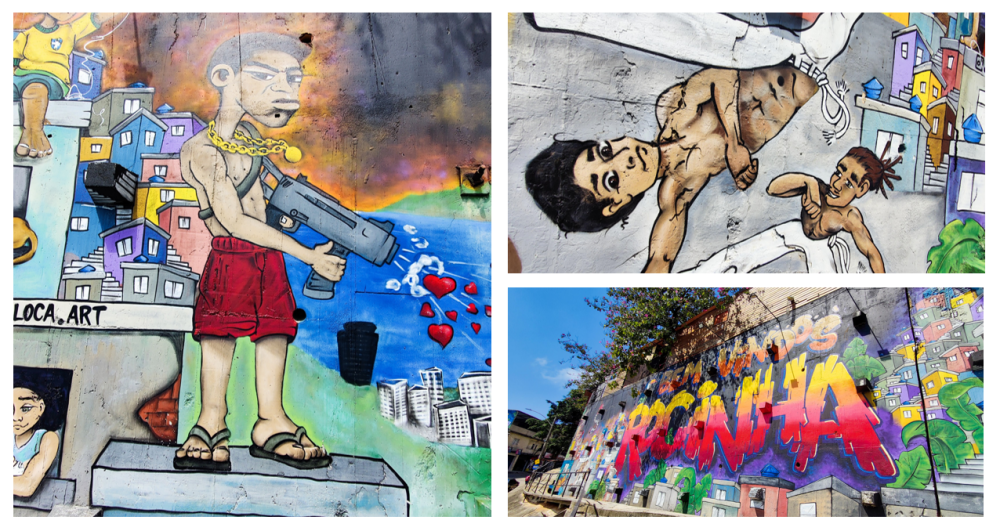
A little further on was the dealing point. Several dozen guards armed with AK-47s, sniper rifles or machine guns were standing guard near a table set up in the middle of the street. Cocaine and marijuana were the main products for sale. A little apart, in a bar, we saw the accountant sorting several bundles of money. This seemed out of the ordinary to us, but in reality it was an everyday scene in the favela. Seeing us a little perplexed, one of the clan leaders approached the guide and said: “Don’t worry, you can relax. You have nothing to fear here. Just no pictures.”
We were told that the traffic had other sources of profit such as racketeering. When a business wants to set up in the favela, it has to pay “taxes”. This concerns especially the activities of: sale of gas, transport, installation of wi-fi and TV cable which bring in up to 400k€ per week. In return for these juicy profits, these small local warlords cannot leave the favela and their life expectancy is very short.

What is counter-intuitive is that these organizations are not only seen as bad by the community. In some cases, they help families in need with food, medicine… They help more than the government, which has sometimes abandoned these families by deserting their neighborhoods.
We would never have done this without a guide who knew the area perfectly and, above all, had the right connections. What will remain engraved in our memory is the age of these young people who get drawn in. Maybe because of the lack of opportunities offered to them, or because some of them no longer believe in their future. Especially since the guide explained to us that a vicious circle has set in: many girls become pregnant at around 15-16 and end up raising their children alone. Their difficulty in making ends meet often has a detrimental effect on the education and future prospects of their children.
Why do so many people continue to crowd into the favelas?
One of the main reasons is transportation to work. Many people work in the center of the city. Living outside the favelas would take too much time and be too expensive.
Although often neglected by the government, the favela residents are essential to the smooth running of the city. The drivers, the security guards, the cashiers, the surface technicians, the nannies… most of them live in the favelas. The drug traffickers that we have in mind represent only a tiny minority.
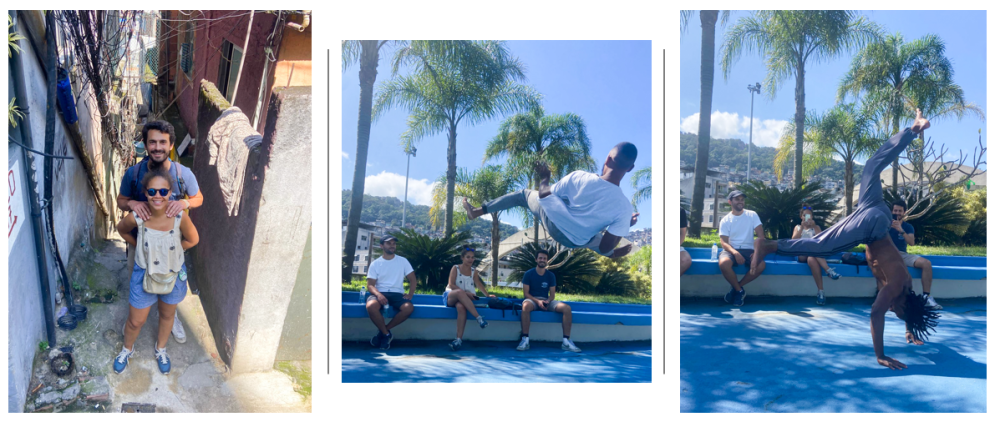
At the end of this day full of discoveries, we met a talented capoeira group. They shared their art and their passion with us. There is incredible talent in the favela of Rocinha too.
Tomorrow is the big return!
Have a nice day, everyone, and see you soon,
Sarah & Romain